


Gary Peterson - February 26, 2024
(The first six postings of the blog serve as an introductory set.)
Dr. Jill Bolte Taylor, TED Talk 2008 entitled ‘My Stroke of Insight’:
“I believe that the more time we spend choosing to run the deep inner-peace circuitry of our right hemispheres, the more peace we will project into the world, and the more peaceful our planet will be.”
If you have never watched her TED talk, it is well worth the 18 minutes of your time.
In 2008, a year before the release of McGilchrist’s The Master and His Emissary, a new idea about how our brain functions exploded into the Western imagination. Harvard brain researcher Dr. Jill Bolte Taylor, who in 1996 had experienced a left brain hemisphere stroke, gave the first TED Talk that went viral. Within six months, she had a book on The New York Times bestseller list, was chosen as one of TIME magazine’s “100 Most Influential People in the World” and was the premiere guest on Oprah Winfrey’s “Soul Series” webcast.
Being a brain scientist, she was able to study her stroke as it happened and then gave a vivid account of its effects as her left brain hemisphere’s consciousness alternately went offline and came back online. She experienced two separate consciousnesses, one focused on the world of things in space and time, and the other aware of a vast undifferentiated spaciousness of energy, bliss, and love. When her left hemisphere went offline, she recalls:
“Because I could not identify the position of my body in space, I felt enormous and expansive, like a genie just liberated from her bottle. And my spirit soared free, like a great whale gliding through a sea of silent euphoria. Nirvana. I found Nirvana. And I remember thinking, there’s no way I would ever be able to squeeze the enormousness of myself back inside this tiny little body. Then I realized, if I have found Nirvana and I’m still alive, then everyone who is alive can find Nirvana. And I pictured a world filled with beautiful, peaceful, compassionate, loving people who knew that they could come to this space at any time. And that they could purposely choose to step to the right of their left hemisphere – and find this peace. And then I realized what a tremendous gift this experience could be, what a stroke of insight this could be to how we live our lives.”
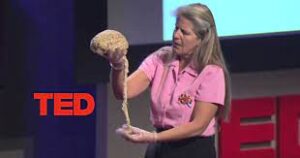
Jill Bolte Taylor
This groundbreaking perspective on the brain hemispheres’ different kinds of consciousness was based on her scientific knowledge, personal experience and intuition. Those with an interest in Eastern philosophies or who have studied meditation disciplines can see how her ideas might provide new ways of explaining meditation practices and the associated changes that occur in the brain. However, like all new ideas, a healthy skepticism required questioning whether this new approach would withstand the test of time and scientific challenges. Now, more than 15 years later, not only have Jill Bolte Taylor’s ideas aged well, they have been hugely supplemented and enhanced by Iain McGilchrist’s two books.
Jill Bolte Taylor took eight years to fully recover from her stroke. Slowly, she reclaimed the capabilities provided by her left hemisphere. She had to learn to create shapes, colors and “things” again. During those years, she had the opposite of the problem that normal meditators face. Initially, the stroke left her experiencing life almost entirely from the right hemisphere’s perspective. As a result, she lived in a state of unity and connection, not separation. Today, she has no need to meditate as she moves with ease into the consciousness of her right hemisphere. Unfortunately – or fortunately – this path cannot be ours. However, in a new book titled Whole Brain Living, she introduces a non-meditation technique that she calls the Brain Huddle which consciously and purposefully increases the utilization of the right hemisphere.
The Spiritual Right Hemisphere
Is the spiritual path primarily a matter of getting the left hemisphere out of the way? It seems that all spiritual pursuits involve increasing the utilization of the right brain hemisphere, whether that be:
- seeking Truth through experience
- expanding one’s consciousness, knowing the unconscious and/or the ground of being
- enhancing a sense of connection and interconnectedness
- knowing/experiencing G-d, Cosmic Consciousness, Christ Consciousness, Buddha mind, The Tao
- finding liberation, freedom, peace, and bliss in a higher identity
- living in harmony with nature
- being present in the Now
- wanting to live in compassion, loving kindness, humility, and awe
- developing intuition, imagination
The explicit content of the left hemisphere normally obscures the subtle conscious awareness of the right hemisphere. It seems that quieting the left hemisphere is an essential first step. In meditation traditions, we learn to minimize and control the mind’s explicit content through concentration practices. This is necessary before learning how to create conditions that sustain and strengthen the right hemisphere’s subtle awareness.
McGilchrist contends that the right hemisphere is comfortable with mystery, has a power to integrate paradoxical ideas and information, something the left hemisphere cannot do. He explains:
“The right hemisphere is better at accepting uncertainty and limits to knowledge. An understanding of the divine must rely on indirect and metaphorical expression, not direct and literal expression; it must tolerate ambiguity; and it has to be at ease with accepting that both of what, on the surface, appear to be contradictory elements might be true – in other words, it must be receptive to what we call paradox.”
In the end, McGilchrist holds that both hemispheres must work together but in a different way. To me, a key component of the spiritual journey is permanently altering the relationship between the two hemispheres, which not only changes the kind of attention we pay the world, but also transforms our values and our sense of self.
And what happens when both the left and right hemisphere go quiet? What kind of consciousness arises then? There is some intriguing evidence to consider. First, EEG studies of subjects who have taken psylocibin, the active ingredient in magic mushrooms, show that at the height of their psychedelic experiences — the brain goes quiet. Second, there is the story of Dr. Eban Alexander, a neurosurgeon who also trained at Harvard. His 2012 bestselling book was Proof of Heaven. He suffered a severe brain infection, effectively shutting down the brain function related to normal consciousness in both hemispheres of the brain. Despite minimal EEG activity he experienced a complex, sacred, loving consciousness far beyond our earthly realm. Can we experience what some call big “C” Consciousness — when our brains get out of the way?
Intriguing Parallels
At the end of her TED talk, Jill Bolte Taylor points to a trinity and asks the we recognize that “we are the life force power of the universe (embodied) with two cognitive minds.” Over the years, I have been surprised at how well this correlates with other trinities in Eastern spiritual traditions. Briefly, here are parallels I have found most intriguing.
In the Mahamudra (Buddhism) tradition, there is the coarse mind, the subtle mind, and the very subtle mind, whose functions also correlate with her trinity. Then there is the attainment of the three Buddha bodies during Enlightenment, when the three levels of mind manifest simultaneously. Descriptions of the dharmakaya (truth body), sambhogakaya (enjoyment body), and nirmanakaya (emanation body) also associate well with her trinity. In Hindu philosophy, the Advaita Vedantic tradition recognizes three levels/degrees of reality/experience: the prathibhasika (subjective experience), the vyavaharika (empirical experience), and the paramarthika (ultimate spiritual experience). Obviously, the “life force power” can describe what several Eastern spiritual traditions call the “ground of being, ” or big “C” Consciousness, which transcends human – little “c” — consciousness.
McGilchrist’s hemisphere hypothesis not only supports, but also offers explanations of the processes of these trinities. It appears our brains constrain and shape this larger consciousness and then provide two different takes (big picture flow, focus on things/details) on a differentiated and seemingly local reality. I believe all these parallels are ripe for exploration. Hence this blog. Your thoughts are welcomed.