


Gary Peterson - February 26, 2024
(The first six postings of the blog serve as an introductory set.)
If you are a Westerner pursuing an Eastern spiritual path that includes Buddhist meditation, you likely know how difficult it is to attune and reconcile your habitual world views to those of Buddhism. In the West, we are taught that matter and things composed of matter are fundamental to our universe. In Buddhism, we are instructed instead to turn our attention inward, to focus on how we utilize our minds, and to discover — quite to the contrary — that all is mind. It is difficult to reconcile these two philosophies and their very different views of reality within ourselves, let alone explain this process to others. Until now, Westerners seeking explanations have largely relied on translations of Eastern spiritual texts that utilize obscure language, metaphors and imagery which often fail to resonate with those educated in the West. Now, largely unnoticed, a new Western approach to this dilemma has been addressed in two innovative and ambitious books by a British psychiatrist and philosopher. In 2009, Iain McGilchrist released The Master and His Emissary, which provided a groundbreaking “hemisphere hypothesis” about how the brain functions and how these processes shape us and our relationships with the world. He followed up in 2021 with a 1500-page work that expanded the hemisphere hypothesis and explained how each brain hemisphere provides different takes on science, reason, intuition and imagination. This book has an unusual title, employing a simple pun for this complex topic, The Matter with Things.
The hemisphere hypothesis holds that our right and left brain hemispheres function very differently, provide different kinds of attention to the world, and provide very different takes on truth and reality. While the left hemisphere specializes in reducing our view of the world to details and how it can manipulate those details, the right hemisphere continually seeks to provide a coherent “big picture.” Dr. McGilchrist offers that our views of the world and the qualities of our relationships are largely determined by which hemisphere is more dominant. This hemisphere hypothesis is a revolutionary idea for Western science and thinking, as we have little knowledge of the workings of our mostly silent right hemisphere. Far ahead of others, Dr. McGilchrist posits that Eastern philosophies are guided by a holistic view that is a result of the natural dominance of the right brain hemisphere. He asserts we must consciously utilize our right brain hemisphere as the Master, not as the Emissary, a choice that will naturally align us with truth, beauty, goodness and compassion.
McGilchrist holds that current Western thinking — and our society — is largely a product of a vocal, more contrived, and less truthful consciousness that is employed by the left brain hemisphere. He believes that much of what is wrong with Western life is due to the unnatural dominance of left brain hemisphere, which is constantly reinforced by societal norms. He repeatedly demonstrates how current Western thought is inherently shortsighted, and that it is today producing a metacrisis — failing us as individuals, weakening our social connections, destroying the planet, and severing our connection to the sacred.
To remedy this, he submits that a more mindful consciousness, traditionally manifesting in the Eastern mind, is essential to changing not only how we see ourselves but how we approach and interact with the world. Truth and reality, as seen by the right hemisphere, align remarkably well with Buddhist teachings. The positive qualities of mind emphasized in Buddhist teachings manifest and are strengthened when the right hemisphere becomes dominant. Anyone who has pursued Buddhist meditative teachings will immediately recognize how the practices of mindfulness, concentration with and without attributes, insight, and emptiness correspond to McGilchrist’s descriptions of the different processes of consciousness utilized by the right and left brain hemispheres. While McGilchrist never overtly endorses Buddhist practices, he points to these correlations throughout his latest book. How the Eastern spiritual traditions could be reinforced or even transformed by the hemisphere hypothesis remains unexplored territory.
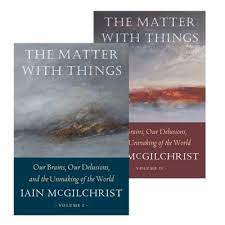
In Part III of The Matter with Things, McGilchrist performs a tour-de-force in modern Western philosophy about the basis of reality. In great depth and scope, McGilchrist examines how our two hemispheres apprehend, process, and create two very different realities. These views of reality are obviously complementary, but they are also often paradoxical, if not opposites. He then examines the fundamentals of reality — time, flow, movement, space, matter, consciousness, value and purpose – through each hemisphere’s perspective. His explanation how all these aspects of reality are apprehended by the right hemisphere will be recognizable to long-term students and practitioners of Eastern meditation. In the end, he concludes that we in the West embrace the left hemisphere’s view and as a result, we misunderstand the nature of reality. McGilchrist is now among the few current Western thinkers and scientists who will accept that consciousness, not matter, is fundamental. Accordingly, he posits that our brain hemispheres do not produce consciousness, but rather filter or transduce consciousness in very different ways. His conclusions have thus far received little noticed. While these ideas are difficult for followers of Western science to embrace, they are not unusual to the Eastern mind.
By embracing consciousness as fundamental, I believe McGilchrist has laid a foundation for building a bridge between the West and Eastern spiritual traditions. The Matter with Things makes extensive use of Western neurology, physics and nearly forgotten Western philosophy that support this deeper understanding of reality and mind. Modern physics is leading the way in the West in replacing a matter-only view. Today, most particle physicists will concur that we exist in a psycho-physical reality where our attention changes and creates what we experience. We can have no knowledge of the world without our consciousness being part of that knowledge. As the famous double-slit experiment proves, our mind – a.k.a. ‘the observer’ — changes light from waves to particles. McGilchrist opens our eyes to the fact that these phenomenon (complementarity) occurs at both small and large scales of existence. The book also highlights several Western thinkers and philosophers who long ago intuitively reached similar ideas, but were largely ignored when industry and technology exploded in the West and our modern age of materialism and the machine model of reality took hold. In the title of the book, McGilchrist points to the life-changing philosophical shift that truth-seeking Westerners will have to undertake; i.e. to see that things, when held within a more holistic and truthful consciousness, are instead processes, events and relations… of consciousness.
As someone who has studied Buddhist meditation technologies, specifically Mahamudra and Bon tradition Dzogchen practices, I believe the hemisphere hypothesis can be seen as a new tool for Eastern meditation and contemplation practices. In future blog postings I will write about many of McGilchrist’s ideas and insights and how they might be used as part of a bridge to make Eastern spiritual traditions more accessible for Westerners. I hope others who are studying Eastern spiritual traditions will find his work relevant and will eventually join me in mining the treasures from his work. The material is often very challenging, but at the same time you will frequently be in awe of the depth and breadth of McGilchrist’s knowledge. Having a dictionary, web browser and note pad nearby are virtually required. Those wishing an introduction to his work can view any of several free YouTube videos that are online. I recommend this 1-hour talk on the metacrisis he recently gave at the University of Cambridge and this 1-hour summary of the hemisphere hypothesis he presented last year at CERN in Switzerland. I also am planning to include the work of other Westerners who are helping to bridge the East/West divide.
As Dr. McGilchrist repeatedly states, the path to the reconciliation of opposites is where the greatest truths are found. Opposites fulfill each other. East and West. Left hemisphere and right hemisphere. Matter and mind. Wave and particle. Implicit and explicit. Potential and actual. Yin and yang. As challenging as this may be, I believe this reconciliation of opposites is among the most important work of our lifetimes.
Thanks so much, Gary, for introducing me to McGilchrist’s work and ideas. You’ve written a wonderful preface here to going deeper into his work, and I’m looking forward to joining in the exploration! It’s really exciting stuff, and my mind is already exploding with thoughts and questions that correlate to this line of thinking. As someone who has struggled all my life with being primarily right brained in a left brained society (along with being dyslexic and ‘ADD’) I’ve always felt secretly privileged to be able to see and experience the world the way I do. And although , on both a local scale and globally, I’ve found my ‘tribe’ of like minded people in everything from politics to lifestyle, I’m increasingly aware of the sad fact that the world is becoming more divided as the characteristics of right vs left brain thinking seem to be becoming more pronounced. I’m looking forward to taking part in the discussions that your blog will evoke!
Thanks, Melinda. You’re #1 — literally! As someone whose favorite book is The Order of Time, I knew you’d be interested in his work. There’s a lot to talk about here… hopefully on a sunny beach day!